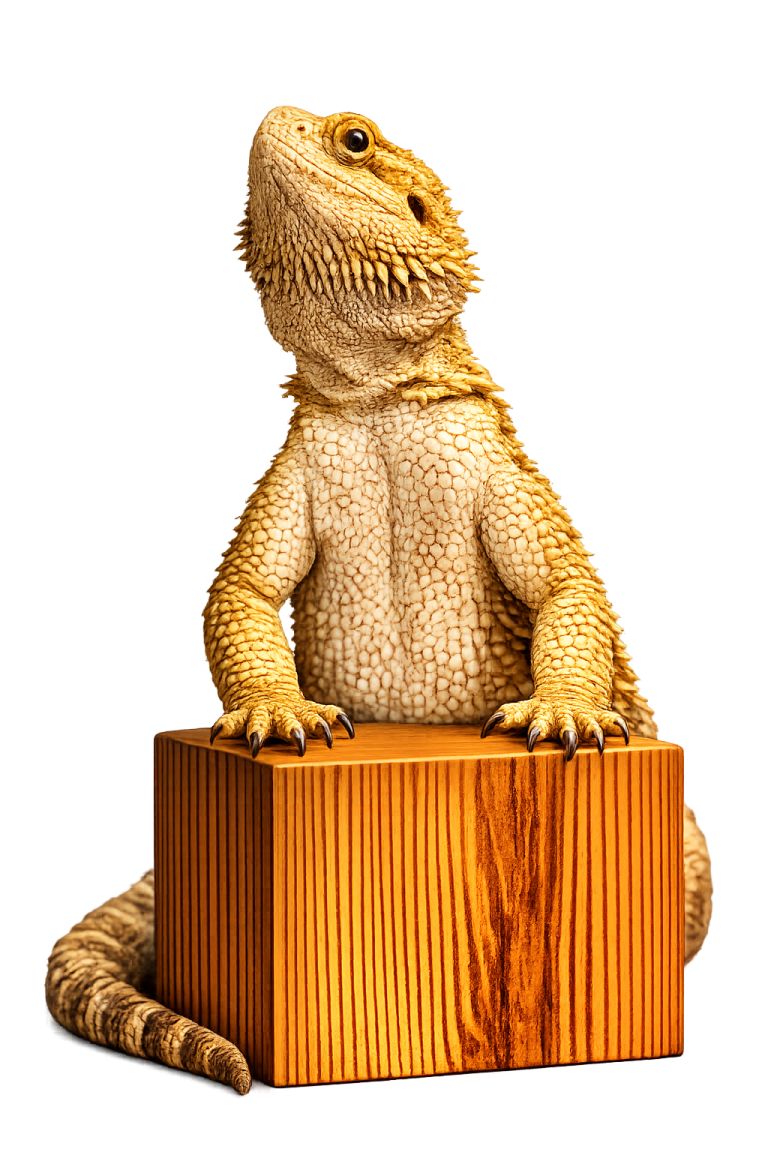
Bearded Dragon Care Sheet
Quick Facts
| Species | Pogona vitticeps |
|---|---|
| Level | Intermediate |
| Enclosure | 180 × 90 × 90 cm |
| Temp. / RH | W 32–35°C · C 25–29°C RH 30–40% |
| Adult size | 45–60 cm |
| Lifespan | 10–15 years |
Care & Husbandry
Bearded dragons are known for their robust build, distinctive beard display and active daytime basking behaviour. This care sheet covers the essential husbandry requirements, including housing, temperature, humidity, feeding, lifespan and common health challenges.
Natural Habitat
Central bearded dragons inhabit a range of Australian dry landscapes, including scrub, open woodland and semi-arid country. Vegetation, fallen wood, rocks and sheltered ground interrupt the open spaces. They use elevated positions as well as the ground; a natural setup should accommodate climbing and digging rather than resemble an empty sand box.
Housing
Adult bearded dragons (Pogona vitticeps) should be housed in an enclosure measuring at least 180 × 90 × 90 cm. An enclosure of 210 × 90 × 90 cm or larger is recommended where space allows, providing additional room for movement, thermoregulation, climbing and environmental enrichment.
The enclosure should include a broad basking surface, secure hides, sturdy branches, rocks, logs and other furnishings that allow the bearded dragon to climb, explore and retreat from view. Furnishings should provide varied elevations while remaining stable and safe. A suitable substrate should support natural terrestrial movement and digging behaviour.
Fresh, clean drinking water should always be available in a stable, shallow dish. Bearded dragons should generally be housed individually because they are territorial and cohabitation can result in competition, stress and injury.
A strong, consistent day-night cycle should be provided. Bearded dragons require high-quality linear UVB lighting, with an appropriate gradient reaching approximately UVI 4.0–4.5 at the basking position. UVB exposure should be determined by actual output at the animal’s basking position rather than bulb percentage alone. Bright visible daytime lighting should also be provided.
Temperature & Humidity
Provide a strong thermal gradient so the bearded dragon can regulate its body temperature effectively. The basking surface should reach approximately 42–45°C, while the cooler portion of the enclosure should remain approximately 22–26°C. Night-time temperatures can generally fall to approximately 18–24°C.
Basking temperature refers to the temperature of the basking surface rather than the surrounding air. Surface temperatures should be checked using an infrared thermometer, while ambient temperatures should be monitored with accurate digital probes. Heating equipment should be appropriately controlled and accessible heat sources protected against direct contact.
Ambient humidity should generally remain around 30–40%, although natural fluctuations and somewhat higher humidity in cooler microclimates can occur. Persistently damp substrate and stagnant conditions should be avoided, while adequate ventilation should be maintained.
Feeding
Bearded dragons are omnivorous and should receive a varied diet of appropriately selected leafy greens, vegetables and live invertebrates. Suitable feeder insects include crickets, locusts, roaches, silkworms and other appropriately sized species. Feeder insects should be appropriately gut-loaded before feeding.
Juveniles should generally be offered appropriately sized food daily and require a substantially greater proportion of animal-based food to support growth. The proportion of plant matter should progressively increase as the animal matures.
For mature adults, approximately 80–90% of the diet can consist of suitable plant matter, with approximately 10–20% consisting of appropriately selected invertebrate prey. Exact quantities should be adjusted according to activity, reproductive status and body condition rather than treated as a rigid feeding formula.
Fruit is not nutritionally necessary and should be offered only very sparingly, if at all. High-fat feeder insects should also be restricted, particularly in adults, because bearded dragons are susceptible to obesity.
Appropriate calcium and vitamin/mineral supplementation is essential, particularly during growth and reproduction. Supplementation should be balanced with diet and UVB provision, as both deficiencies and excessive supplementation can cause health problems.
Lifespan
With appropriate housing, nutrition and long-term husbandry, bearded dragons commonly live for approximately 10–15 years in captivity, with some individuals living longer.
Common Health Challenges
- Metabolic bone disease: Inadequate UVB exposure, calcium imbalance or inappropriate supplementation can interfere with normal calcium metabolism and skeletal health.
- Obesity: Excessive food intake, high-fat feeder insects or insufficient activity can result in unhealthy weight gain.
- Dehydration: Inadequate water intake, inappropriate diet or unsuitable environmental conditions can compromise hydration.
- Respiratory disease: Inappropriate temperatures, poor ventilation or persistently unsuitable environmental conditions can contribute to respiratory problems.
- Digestive problems and impaction: Inappropriate temperatures, dehydration, unsuitable food items or ingestion of inappropriate materials can contribute to gastrointestinal obstruction or impaired digestion.
- Thermal injury: Uncontrolled or accessible heating equipment and excessively hot basking surfaces can cause burns.
- Nutritional disorders: An unbalanced diet or inappropriate calcium, vitamin and mineral supplementation can cause nutritional deficiencies or excesses.
- Reproductive disease: Female bearded dragons can develop reproductive disorders such as follicular stasis or egg retention, which require veterinary assessment.
- Parasites: Internal and external parasites can occur, particularly in newly acquired or exposed animals.