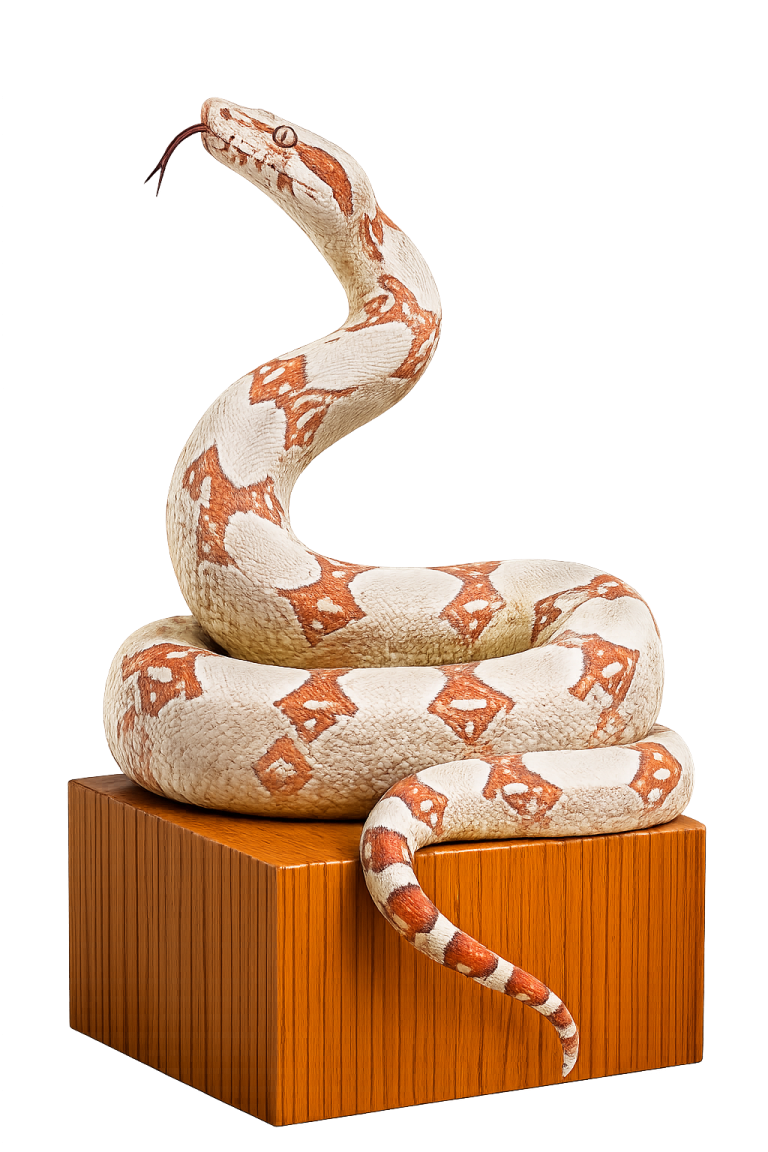
Boa Constrictor Care Sheet
Quick Facts
| Species | Boa imperator / Boa constrictor |
|---|---|
| Level | Intermediate |
| Enclosure | 180 × 90 × 90 cm* |
| Temp. / RH | W 28–30°C · C 24–26°C RH 55–75% |
| Adult size | 150–300+ cm; locality-dependent |
| Lifespan | 25–35 years |
*For boas up to 180 cm long; longer snakes need longer enclosures.
Care & Husbandry
Boa constrictors are known for their powerful build, considerable adult size and variable colouration, with husbandry requirements that differ between species and localities. This general care guide covers the essential husbandry requirements, including housing, temperature, humidity, feeding, lifespan and common health challenges.
Important: This general care guide covers both Boa imperator and Boa constrictor. Adult size, temperature, humidity and other husbandry requirements vary between species, populations and localities, so care should always be refined according to the identified animal. Smaller forms may remain below the adult size range shown above.
Natural Habitat
Boa imperator occurs in parts of Mexico, Central America and north-western South America, while Boa constrictor occurs principally in South America. Across their ranges, these boas occupy varied habitats, including humid tropical forest, seasonally dry forest, woodland edges and scrub. Conditions differ considerably between localities.
Their surroundings may include dense vegetation, leaf litter, fallen trunks, tree branches and sheltered retreats such as hollow logs or abandoned burrows. Boas use both the ground and climbing opportunities, particularly when young. Their natural environment should therefore not be represented as an empty floor or a uniformly wet rainforest enclosure; cover, sturdy climbing structures and a choice of sheltered resting places are important features.
Housing
Adult boa constrictors (Boa imperator and Boa constrictor) require spacious housing that allows them to fully stretch out, move freely, climb and thermoregulate. Enclosure length should at least equal the snake’s adult body length. An enclosure measuring approximately 180 × 90 × 90 cm provides a practical starting point for an adult up to approximately 180 cm, while longer individuals require correspondingly longer housing. An enclosure of approximately 240 × 120 × 120 cm or larger provides additional space, but animals longer than 240 cm require a correspondingly longer enclosure.
Boa constrictors use both terrestrial and elevated areas and should have access to sturdy climbing branches and elevated resting opportunities, particularly when young. The enclosure should also contain multiple secure hides positioned across the thermal gradient and sufficient cover to allow the snake to retreat from view. All elevated structures must be securely anchored and capable of supporting the weight of the snake.
A large, stable water bowl containing fresh drinking water should be available at all times and should allow the snake to soak comfortably if desired. A moisture-retaining substrate should help maintain appropriate humidity without remaining continuously waterlogged. Boa constrictors should generally be housed individually.
A consistent day-night cycle should be provided. Appropriate low-level UVB lighting can be incorporated into the daytime lighting system, with shaded areas and secure hides available so the snake can regulate its exposure.
Temperature & Humidity
Provide a thermal gradient that allows the boa to regulate its body temperature. Warm-side ambient temperatures should remain around 28–30°C, with a local basking zone where the air temperature reaches approximately 30–32°C. The cooler portion of the enclosure should remain around 24–26°C. These are practical starting ranges and should be refined according to species, locality and individual requirements.
The basking-zone value refers to air temperature, not the temperature of the surface beneath the heat source. Basking surfaces can become warmer than the surrounding air and should be checked separately with an infrared thermometer. Air temperatures should be monitored with accurate digital probes positioned at the snake’s level. Heating equipment should be thermostatically controlled and accessible heat sources appropriately guarded.
A modest night-time temperature reduction can be provided. Approximately 22–24°C is a practical overnight range used for many healthy, established animals, rather than a universal requirement. Adjust night-time conditions according to the animal’s origin, age, health and reproductive status.
Ambient humidity should generally fluctuate around 55–75%, although exact requirements vary between species and localities. This is a general working range rather than a strict upper limit; higher humidity may be appropriate during shedding or for particular localities. Consistently appropriate hydration is more important than deliberately raising the entire enclosure to very high humidity only during shedding. A humid hide can provide access to a more humid microclimate when required.
The substrate should retain sufficient moisture to support appropriate humidity without remaining continuously saturated. Adequate ventilation should be maintained, and temperature and humidity should be monitored using accurate digital instruments.
Feeding
Boa constrictors are carnivorous generalists and should receive appropriately sized whole vertebrate prey. Frozen-thawed rodents provide a practical staple diet in captivity, while other suitable whole vertebrate prey can be incorporated for dietary variety.
The following intervals are practical starting points rather than scientifically established feeding requirements. Adjust meal size and frequency to the individual animal’s growth, activity and body condition.
- Juveniles: approximately every 7–14 days.
- Subadults: approximately every 14–21 days.
- Adults: approximately every 21–35 days, with longer intervals of around 4–8 weeks appropriate for some mature animals, depending on meal size and body condition.
Prey size and feeding frequency should always be adjusted according to species, sex, age, size, activity, reproductive status and body condition. Larger meals require correspondingly longer intervals between feedings.
Boa constrictors are efficient feeders and are particularly susceptible to obesity when offered excessively large prey or fed too frequently. Maintaining a lean, muscular body condition is therefore more important than following a rigid feeding schedule.
Frozen-thawed prey is preferable to live prey because it reduces the risk of prey-related injury. A balanced whole-prey diet does not normally require routine calcium or vitamin supplementation.
Lifespan
Boa constrictors are long-lived snakes. A lifespan of approximately 25–35 years is commonly cited in captive-care references, although individual outcomes vary considerably. Exceptional captive longevity records exceed 40 years, so ownership should be approached as a commitment lasting several decades.
Common Health Challenges
- Obesity: Excessive prey size or feeding frequency can cause unhealthy weight gain, particularly in mature and less active animals.
- Respiratory disease: Respiratory infections can involve infectious agents as well as contributing husbandry problems. Inappropriate temperatures, poor ventilation and persistently wet or unhygienic conditions may increase susceptibility. Breathing difficulties, abnormal respiratory sounds or mucus require veterinary assessment.
- Dehydration and shedding problems: Insufficient hydration or unsuitable humidity can result in dehydration and incomplete sheds.
- Thermal injury: Uncontrolled or unguarded heating equipment can cause serious burns.
- Regurgitation: Oversized meals, excessive feeding, inappropriate temperatures, stress or handling too soon after feeding can contribute to regurgitation.
- Reptarenavirus infection and Inclusion Body Disease: Reptarenaviruses are associated with boid inclusion body disease (IBD), which can cause neurological, gastrointestinal and other clinical signs. Infected boas may initially appear healthy, and infection does not always coincide with detectable inclusion bodies or obvious illness. Suspected cases require veterinary assessment and appropriate diagnostic testing.
- Stomatitis: Oral injuries, infection and inappropriate husbandry can contribute to inflammation and infection of the mouth.
- Parasites: External parasites such as snake mites and internal parasites can occur, particularly in newly acquired or exposed animals.