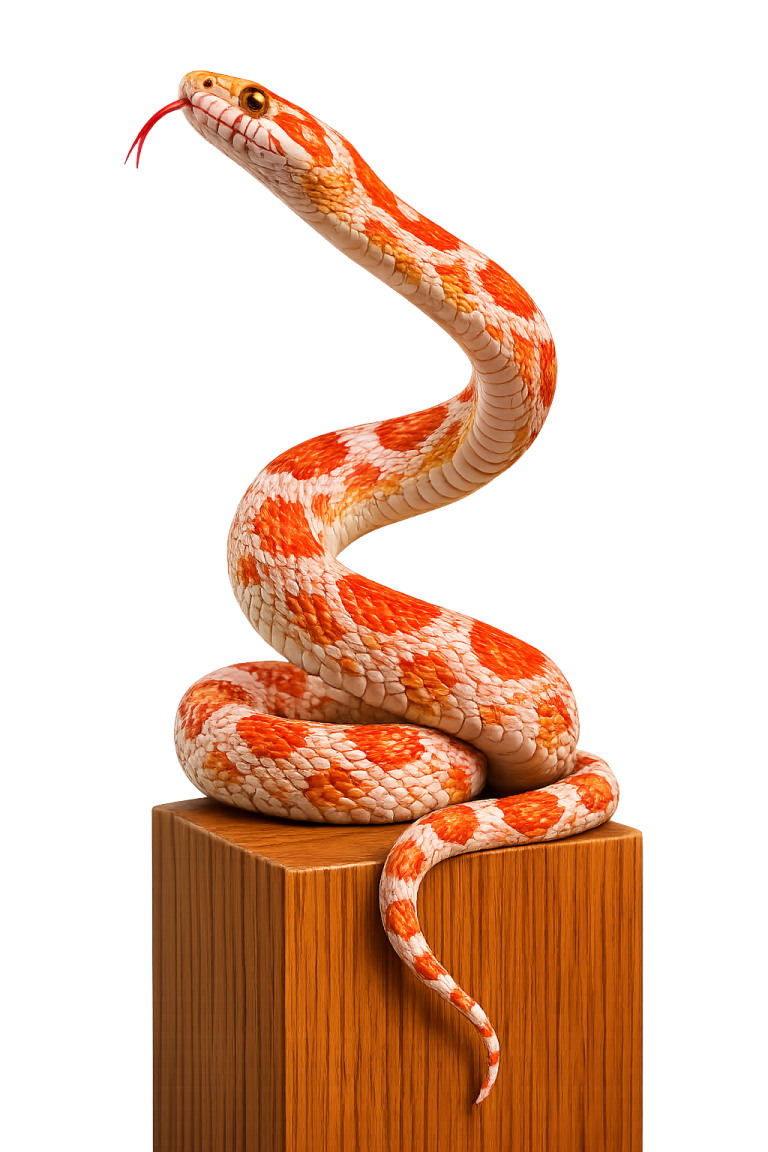
Corn Snake Care Sheet
Quick Facts
| Species | Pantherophis guttatus |
|---|---|
| Level | Beginner |
| Enclosure | 150 × 75 × 90 cm |
| Temp. / RH | W 27–29°C · C 22–26°C RH 40–60% |
| Adult size | 90–150 cm |
| Lifespan | 15–20 years |
Care & Husbandry
Corn snakes are known for their generally calm temperament, attractive colour variations and active, inquisitive behaviour. This care sheet covers the essential husbandry requirements, including housing, temperature, humidity, feeding, lifespan and common health challenges.
Natural Habitat
This species is associated with the south-eastern United States, including woodland, woodland edges and modified landscapes. Ground-level shelter, vegetation and structures used for climbing are important features. A natural-looking enclosure should therefore contain varied cover rather than an open floor with a single ornament.
Housing
Adult corn snakes (Pantherophis guttatus) should be housed in an enclosure large enough to allow them to fully stretch out and express natural exploratory behaviour. An enclosure of 120 × 60 × 60 cm is suitable for an average adult, but individuals longer than 120 cm should be provided with correspondingly longer housing. An enclosure of 150 × 60 × 90 cm or larger provides additional opportunities for climbing, exploration and environmental enrichment.
The enclosure should contain multiple secure hides positioned across the thermal gradient, together with branches, cork, elevated resting opportunities, foliage and other cover. Corn snakes are capable climbers as well as burrowers, so both vertical enrichment and a sufficiently deep, suitable substrate should be provided.
A stable water bowl containing fresh drinking water should be available at all times. The enclosure must be securely closed because corn snakes are skilled at exploiting small gaps. Corn snakes should generally be housed individually.
A consistent day-night cycle should be provided. Appropriate low-level UVB lighting is beneficial, with an approximate basking-zone UV Index of 2.0–3.0. Shaded areas and secure hides should remain available so the snake can regulate its exposure.
Temperature & Humidity
Provide a clear thermal gradient so the corn snake can regulate its body temperature. The basking surface should reach approximately 32°C, while the cooler area should remain around 24–27°C. Night-time temperatures can fall to approximately 20–24°C.
Basking surface temperature should be measured separately from ambient air temperature. Heating equipment should be appropriately controlled, and accessible heat sources should be securely guarded to prevent thermal injury.
Average ambient humidity should generally remain around 65–75%, with natural fluctuations between warmer and cooler areas and between day and night. A humid hide can provide an additional high-humidity microclimate when required, particularly during shedding.
Humidity should not be maintained by keeping the substrate continuously saturated. Appropriate moisture-retaining substrate and adequate ventilation should provide suitable humidity without creating persistently wet or stagnant conditions. Temperature and humidity should be monitored using accurate digital instruments.
Feeding
Corn snakes are carnivorous and should be offered appropriately sized whole prey. Frozen-thawed rodents provide a practical staple diet in captivity, while other suitable whole vertebrate prey can be incorporated for dietary variety.
Hatchlings can generally be fed approximately every 5–7 days, juveniles every 7–10 days, subadults approximately every 10–12 days and adults approximately every 14–21 days. Prey size and feeding frequency should be adjusted according to the snake’s age, size, activity and body condition.
Prey should generally be approximately 1–1.5 times the width of the snake at its widest point. Maintaining healthy body condition is more important than rigidly following a feeding schedule, particularly in mature animals. Frozen-thawed prey is preferable to live prey because it reduces the risk of prey-related injury.
Lifespan
With appropriate housing, nutrition and long-term husbandry, corn snakes commonly live for approximately 15–25 years in captivity, with exceptional individuals capable of approaching 30 years.
Common Health Challenges
- Obesity: Excessive prey size or feeding frequency can result in unhealthy weight gain, particularly in mature animals.
- Respiratory disease: Inappropriate temperatures, poor ventilation or persistently wet and unhygienic conditions can contribute to respiratory problems.
- Dehydration and shedding problems: Inadequate hydration or inappropriate humidity can contribute to dehydration and incomplete sheds.
- Thermal injury: Uncontrolled or inadequately guarded heating equipment can cause serious burns.
- Regurgitation: Excessively large meals, inappropriate temperatures, stress or handling too soon after feeding can contribute to regurgitation.
- Stomatitis: Oral injuries, infection and inappropriate husbandry can contribute to inflammation and infection of the mouth.
- Parasites: Internal parasites and external parasites such as snake mites can occur, particularly in newly acquired or exposed animals.