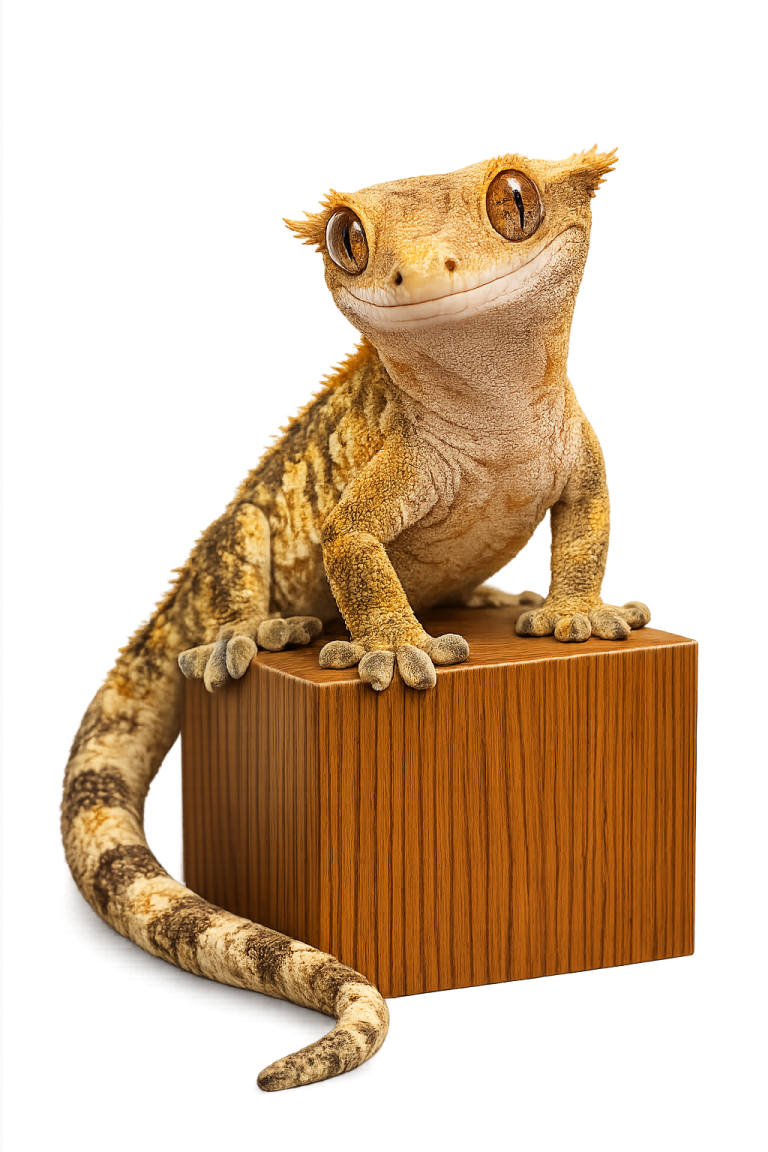
Crested Gecko Care Sheet
Quick Facts
| Species | Correlophus ciliatus |
|---|---|
| Level | Beginner |
| Enclosure | 60 × 60 × 90 cm |
| Temp. / RH | W 24–26°C · C 21–23°C RH 50–80% |
| Adult size | 18–23 cm |
| Lifespan | 15–20 years |
Care & Husbandry
Crested geckos are known for their gentle temperament, distinctive appearance and arboreal lifestyle. This care sheet covers the essential husbandry requirements, including housing, temperature, humidity, feeding, lifespan and common health challenges.
Housing
Adult crested geckos (Correlophus ciliatus) should be housed in a vertically oriented enclosure measuring at least 45 × 45 × 60 cm. An enclosure of 60 × 45 × 90 cm or larger is recommended where space allows, providing additional room for climbing, jumping, exploration and environmental enrichment.
The enclosure should contain cork bark, sturdy branches, vines, dense live or artificial foliage, multiple elevated resting places and secure areas where the gecko can retreat from view. Furnishings should make effective use of the vertical space and provide multiple routes through the enclosure.
Fresh drinking water should always be available in a small, stable, shallow container. Regular misting should also provide droplets on foliage and enclosure surfaces from which the gecko can drink. A suitable substrate should help maintain appropriate humidity without remaining continuously saturated, while good ventilation should prevent stagnant conditions.
Crested geckos should generally be housed individually. They do not require companionship, and cohabitation can result in competition, stress or injury.
A consistent day-night cycle should be provided. Low-output UVB lighting is beneficial, with an approximate basking-zone UV Index of 1.0–2.0. Shaded areas and dense cover should remain available so the gecko can regulate its exposure.
Temperature & Humidity
Provide a thermal gradient that allows the crested gecko to regulate its body temperature. A local basking area of approximately 28–29°C can be provided near the upper part of the enclosure, while cooler areas should remain around 21–24°C. Night-time temperatures can generally fall to approximately 18–22°C.
Heating equipment should be thermostatically controlled and appropriately guarded where necessary. Temperatures should be monitored using accurate digital instruments. Prolonged enclosure-wide temperatures around or above approximately 29°C should be avoided because crested geckos are sensitive to overheating.
Humidity should generally rise to approximately 60–80% after misting. The enclosure should then be allowed to dry gradually, with humidity falling towards approximately 40–50% before another heavy misting. This daily humidity cycle provides hydration while reducing the risk of continuously wet surfaces, mould and stagnant air.
Good ventilation should always be maintained, and humidity should be monitored with an accurate digital hygrometer.
Feeding
Crested geckos are omnivorous and can be maintained on a high-quality, nutritionally complete commercial crested gecko diet (CGD) as their staple food. Appropriately sized live invertebrates, such as crickets, locusts and roaches, can also be incorporated into the diet.
- Juveniles: fresh CGD offered daily, with appropriately sized insects approximately 1–2 times per week.
- Adults: fresh CGD approximately every 2–3 days, with insects approximately 0–1 times per week.
Feeding quantity and frequency should be adjusted according to age, activity, reproductive status and body condition.
Feeder insects should be properly gut-loaded and dusted with an appropriate calcium supplement. Supplementation should take account of the nutritional composition of the complete diet and UVB provision; animals receiving effective UVB generally require less supplemental vitamin D3 than animals maintained without UVB.
Lifespan
With appropriate housing, nutrition and long-term husbandry, crested geckos commonly live for approximately 15–20 years in captivity, with some individuals capable of living longer.
Common Health Challenges
- Metabolic bone disease: Inappropriate calcium and vitamin D3 metabolism resulting from an unbalanced diet, inadequate supplementation or unsuitable lighting can impair normal bone health.
- Dehydration: Inadequate access to water or inappropriate environmental humidity can compromise hydration.
- Retained shed: Unsuitable humidity or hydration can contribute to retained skin, particularly around the toes and other extremities.
- Obesity: Excessive feeding or inappropriate amounts of calorie-dense food can result in unhealthy weight gain.
- Overheating: Crested geckos are sensitive to excessive temperatures, and prolonged exposure to temperatures above their preferred range can cause serious heat stress.
- Tail loss: Crested geckos can shed their tail in response to stress, restraint or injury. The tail does not regenerate after being lost.
- Traumatic injury: Falls, unstable furnishings or conflict during cohabitation can result in injuries.