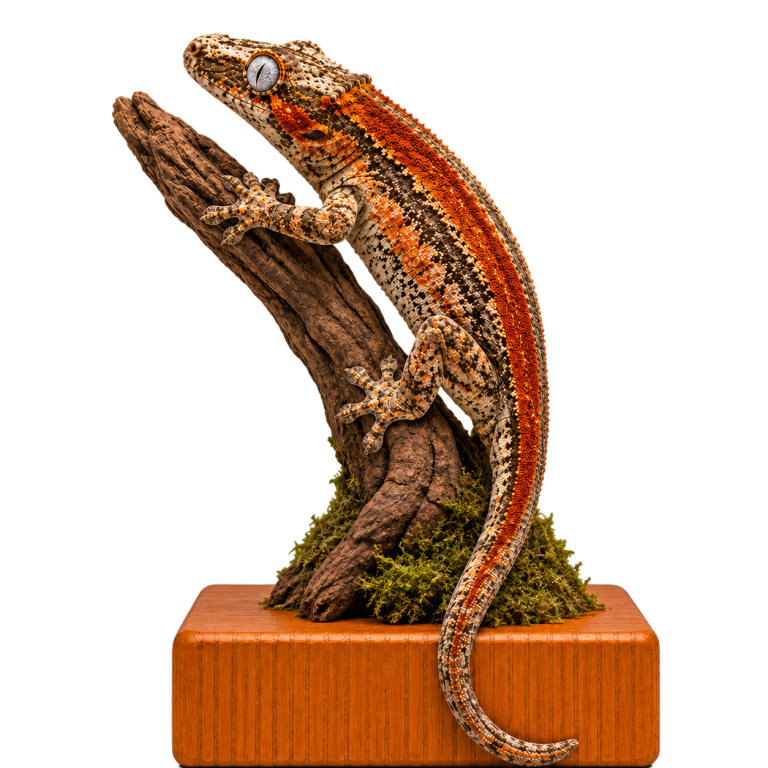
Gargoyle Gecko Care Sheet
Quick Facts
| Species | Rhacodactylus auriculatus |
|---|---|
| Level | Intermediate |
| Enclosure | 60 × 60 × 90 cm |
| Temp. / RH | W 24–26°C · C 22–23°C RH 50–70% |
| Adult size | 20–25 cm |
| Lifespan | 15–20 years |
Care & Husbandry
Gargoyle geckos are known for their distinctive head shape, varied colouration and active arboreal behaviour. This care sheet covers the essential husbandry requirements, including housing, temperature, humidity, feeding, lifespan and common health challenges.
Natural Habitat
Field observations in New Caledonia describe humid forest, shrub-dominated maquis and the transition between them. Shrubs, saplings and relatively narrow trunks are frequently used. This is not exclusively a high-canopy rainforest species; a terrarium should provide usable structure near the floor as well as higher up.
Housing
Adult gargoyle geckos (Rhacodactylus auriculatus) should be housed in a vertically oriented enclosure measuring at least 45 × 45 × 90 cm. An enclosure of 60 × 45 × 90 cm or larger is recommended where possible, providing additional usable space for climbing, jumping, exploration and thermoregulation.
Provide a complex network of sturdy branches, vines and cork positioned at different angles and heights. Dense live or artificial foliage, elevated resting sites and visual barriers should give the gecko opportunities to move throughout the enclosure while remaining concealed when desired. Horizontal resting surfaces are also useful and should be incorporated alongside vertical climbing structures.
Fresh drinking water should always be available in a stable, shallow dish. Misting also provides droplets on leaves and enclosure surfaces from which the gecko may drink. A moisture-retaining substrate can help regulate humidity, but it should not remain continuously saturated.
Gargoyle geckos should generally be housed individually. Permanent cohabitation can result in competition, aggression, injury and tail loss, even when overt conflict is not immediately apparent.
Provide a consistent day-night cycle of approximately 12 hours of daytime illumination. Low-level UVB lighting is recommended, with approximately UVI 1.0–2.0 available in the exposed upper areas of the enclosure. Dense foliage and shaded retreats should allow the gecko to choose lower levels of exposure.
Temperature & Humidity
Daytime temperatures should generally remain around 22–26°C, with a small local basking area reaching approximately 28–29°C. Cooler areas must remain available so the gecko can move away from the heat. At night, temperatures can fall to approximately 20–23°C. Prolonged air temperatures around or above 30°C should be avoided because gargoyle geckos are susceptible to overheating.
Any supplementary heating should be appropriately controlled, and temperatures should be measured at several locations within the enclosure using accurate digital instruments.
Ambient humidity should generally fluctuate around 50–70%. Misting can produce substantially higher short-term readings, but these peaks should be followed by a drying period in which humidity falls towards approximately 50–60%. This cycle provides access to moisture without keeping the enclosure continuously wet.
Adequate ventilation is essential for preventing stagnant air and persistently damp surfaces. Humidity should be monitored with an accurate digital hygrometer.
Feeding
Gargoyle geckos are omnivorous and consume both fruit-based foods and animal prey. A nutritionally complete commercial crested gecko diet (CGD) is suitable as the staple captive food, supplemented with appropriately sized live invertebrates such as crickets, roaches and locusts.
Juveniles should generally have fresh CGD available daily, with appropriately sized insects offered approximately 2–3 times per week. Adults can generally be offered CGD every other day, with insects approximately 1–2 times per week. Feeding quantity and frequency should be adjusted according to age, growth, activity, breeding status and body condition.
Feeder insects should be appropriately gut-loaded and dusted with a suitable calcium supplement. Supplementation should take account of the nutritional content of the complete diet and the gecko’s UVB provision. All prey should be appropriately sized for the individual animal.
Lifespan
With appropriate housing, nutrition and long-term husbandry, gargoyle geckos commonly live for approximately 15–20 years in captivity, with some individuals capable of living for more than 20 years.
Common Health Challenges
- Metabolic bone disease: Inadequate calcium and vitamin D3 metabolism resulting from inappropriate nutrition, supplementation or UVB provision can impair skeletal health.
- Dehydration: Insufficient access to water or an inappropriate humidity cycle can compromise normal hydration.
- Retained shed: Inadequate hydration or unsuitable humidity can result in retained skin, particularly around the toes and other extremities.
- Obesity: Excessive food intake or frequent calorie-dense foods can lead to unhealthy weight gain.
- Overheating: Prolonged exposure to excessive temperatures can cause potentially serious heat stress.
- Floppy tail syndrome: Abnormal tail positioning can develop in captive geckos. The exact cause is not fully understood, although resting posture and enclosure structure may contribute.
- Tail loss: Gargoyle geckos can voluntarily shed their tail following injury, restraint, conflict or severe stress. A regenerated tail may differ in appearance from the original.
- Parasites: Internal parasites and external mites can occur, particularly in newly acquired or exposed animals.