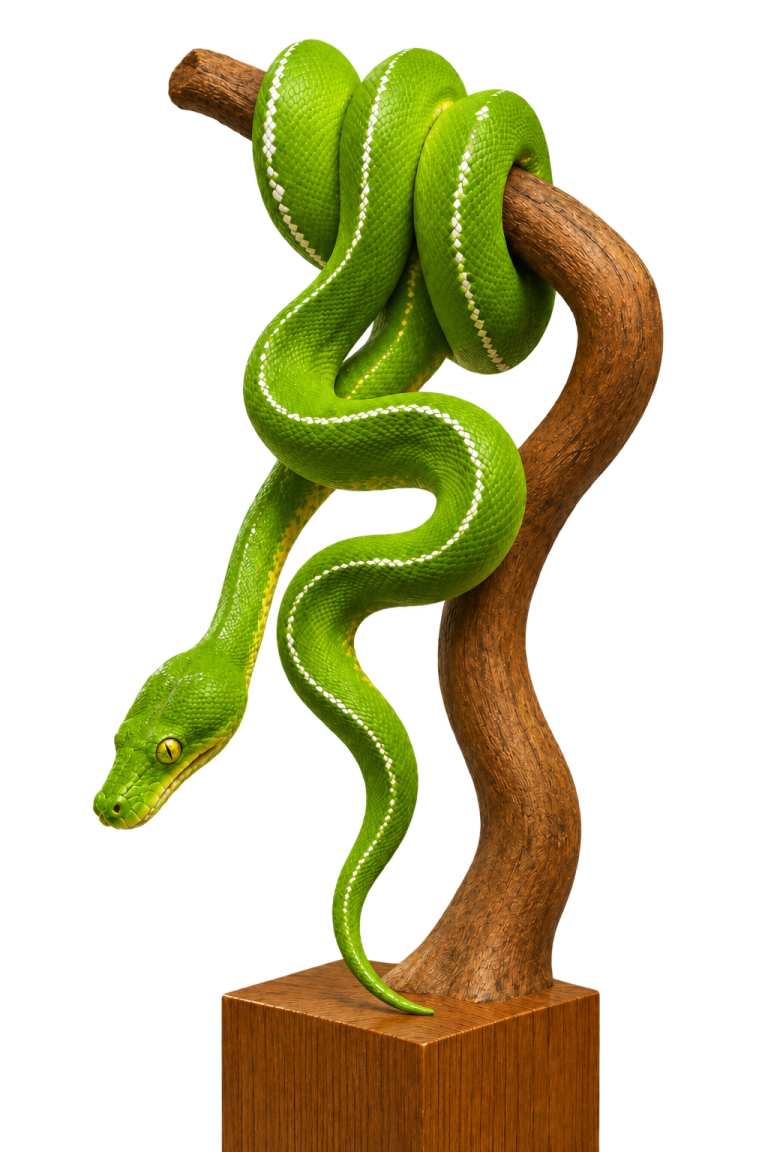
Green Tree Python Care Sheet
Quick Facts
| Species | Morelia viridis / Morelia azurea |
|---|---|
| Level | Advanced |
| Enclosure | 120 × 60 × 120 cm* |
| Temp. / RH | W 29–30°C · C 24–26°C RH 50–70% |
| Adult size | 120–180 cm; occasionally larger |
| Lifespan | 15–20+ years |
*For snakes up to 120 cm long; longer snakes need longer enclosures.
Care & Husbandry
Green tree pythons are known for their vibrant colouration, slender build and highly specialised arboreal lifestyle. This care sheet covers the essential husbandry requirements, including housing, temperature, humidity, feeding, lifespan and common health challenges.
This general care guide covers both Morelia viridis and Morelia azurea, which are commonly traded as green tree pythons. Care should be refined according to the animal’s age, origin and individual requirements.
Natural Habitat
Green tree pythons occur in New Guinea and surrounding islands, with Morelia viridis also occurring on Australia’s Cape York Peninsula. They inhabit tropical rainforest and other densely vegetated forest habitats, including forest edges and secondary growth.
Their surroundings contain layers of branches, climbing vegetation and leafy cover, with shaded resting places and occasional openings where sunlight reaches through the canopy. They spend much of their time perched above ground but also move between vegetation layers and sometimes descend to the forest floor. Rainfall and humid air are characteristic of these habitats, but exposed branches and leaves can dry between showers.
Housing
Adult green tree pythons (Morelia viridis and Morelia azurea) should be housed in an arboreal enclosure that allows them to fully stretch out, climb and move between different temperatures. An enclosure of 120 × 60 × 120 cm provides a practical starting point for an animal up to approximately 120 cm long. Longer individuals require correspondingly longer housing, and additional space provides further opportunities for exploration and environmental enrichment.
The enclosure should contain multiple secure horizontal perches positioned at different heights and temperatures. Perches should have suitable diameters that allow the snake to coil around them comfortably and must be firmly secured. Dense live or artificial foliage, visual cover and additional branches should provide security and allow movement throughout the enclosure.
Usable horizontal and diagonal space is important as well as enclosure height. The arrangement of perches should allow the snake to move between warmer and cooler locations without needing to descend completely to the enclosure floor.
A stable water bowl containing fresh drinking water should be available at all times. A moisture-retaining substrate can help maintain appropriate humidity, but it should not remain continuously wet. Green tree pythons should generally be housed individually.
A consistent day-night cycle should be provided. Appropriate low-level UVB lighting can be incorporated into the daytime lighting system, with shaded areas and dense cover available so the snake can regulate its exposure.
Temperature & Humidity
Provide a thermal gradient that allows the green tree python to regulate its body temperature. Aim for an air temperature of approximately 29–30°C around the warm perch, while cooler resting areas should remain around 24–26°C. These temperatures should be available at usable perch positions rather than only at the enclosure floor. These are practical starting ranges and should be refined according to the animal’s origin and individual requirements.
Air temperatures should be measured using digital probes at the locations actually used by the snake, particularly around the warm perch. Perch surfaces beneath a heat source can become warmer than the surrounding air and should be checked separately with an infrared thermometer. Heating equipment should be thermostatically controlled and all accessible heat sources appropriately guarded to prevent thermal injury.
A modest night-time temperature reduction can be provided. Approximately 22–24°C is a practical overnight range used for many healthy, established animals, rather than a universal requirement. Adjust night-time conditions according to the animal’s origin, age, health and reproductive status.
Ambient humidity can generally fluctuate around 50–70%, with temporary higher levels following misting. The enclosure should subsequently be allowed to dry partially. Constantly saturated substrate and continuously wet enclosure surfaces should be avoided.
Hatchlings and juveniles are particularly susceptible to dehydration and require careful monitoring of hydration and environmental conditions. Good ventilation remains essential even when maintaining relatively high humidity.
Temperature and humidity should be monitored using accurate digital instruments positioned appropriately within the enclosure.
Feeding
Green tree pythons are carnivorous and should be offered appropriately sized whole vertebrate prey. Frozen-thawed rodents provide a practical staple diet in captivity, while appropriately sized birds can also be incorporated for dietary variety.
The following intervals are practical starting points rather than scientifically established feeding requirements. Adjust meal size and frequency to the individual animal’s growth, activity and body condition.
- Hatchlings and young juveniles: approximately every 7–10 days.
- Juveniles and subadults: approximately every 10–14 days.
- Adults: approximately every 14–28 days, depending on meal size and body condition.
Prey size and feeding frequency should be adjusted according to age, size, activity, reproductive status and body condition. Larger meals require correspondingly longer intervals between feedings.
Green tree pythons can become overweight when fed excessively. Maintaining a lean, healthy body condition is more important than adhering rigidly to a feeding schedule. Frozen-thawed prey is preferable to live prey because it reduces the risk of prey-related injury.
Lifespan
With appropriate housing, nutrition and long-term husbandry, green tree pythons can live for approximately 15–20 years in captivity, with some individuals living longer. This is a practical lifespan estimate rather than a guaranteed expectation.
Common Health Challenges
- Dehydration: Inadequate hydration or inappropriate humidity cycling can cause dehydration, with hatchlings and juveniles particularly vulnerable.
- Respiratory disease: Respiratory disease can involve viral, bacterial or fungal infections. Inappropriate temperatures, poor ventilation and persistently wet or contaminated conditions may increase susceptibility, but respiratory signs should not automatically be attributed to husbandry alone.
- Nidovirus infection: Serpentoviruses, commonly referred to as snake nidoviruses, have been associated with severe and sometimes fatal respiratory disease in green tree pythons. Signs may include excess oral mucus and difficulty breathing, although sudden deterioration can occur with few earlier signs. Suspected cases require prompt veterinary assessment and appropriate diagnostic testing.
- Obesity: Excessive prey size or feeding frequency can cause unhealthy weight gain, particularly in mature animals.
- Regurgitation: Excessively large meals, inappropriate temperatures, stress or handling too soon after feeding can contribute to regurgitation.
- Shedding problems: Inadequate hydration or inappropriate humidity can contribute to incomplete sheds.
- Thermal injury: Uncontrolled or inadequately guarded heating equipment can cause serious burns.
- Handling injuries: Green tree pythons often maintain a strong grip on their perch. Forcing a coiled snake from a perch can cause spinal, tail or soft-tissue injuries.
- Stomatitis: Oral injuries, infection and inappropriate husbandry can contribute to inflammation and infection of the mouth.
- Parasites: Internal parasites and external parasites such as snake mites can occur, particularly in newly acquired or exposed animals.