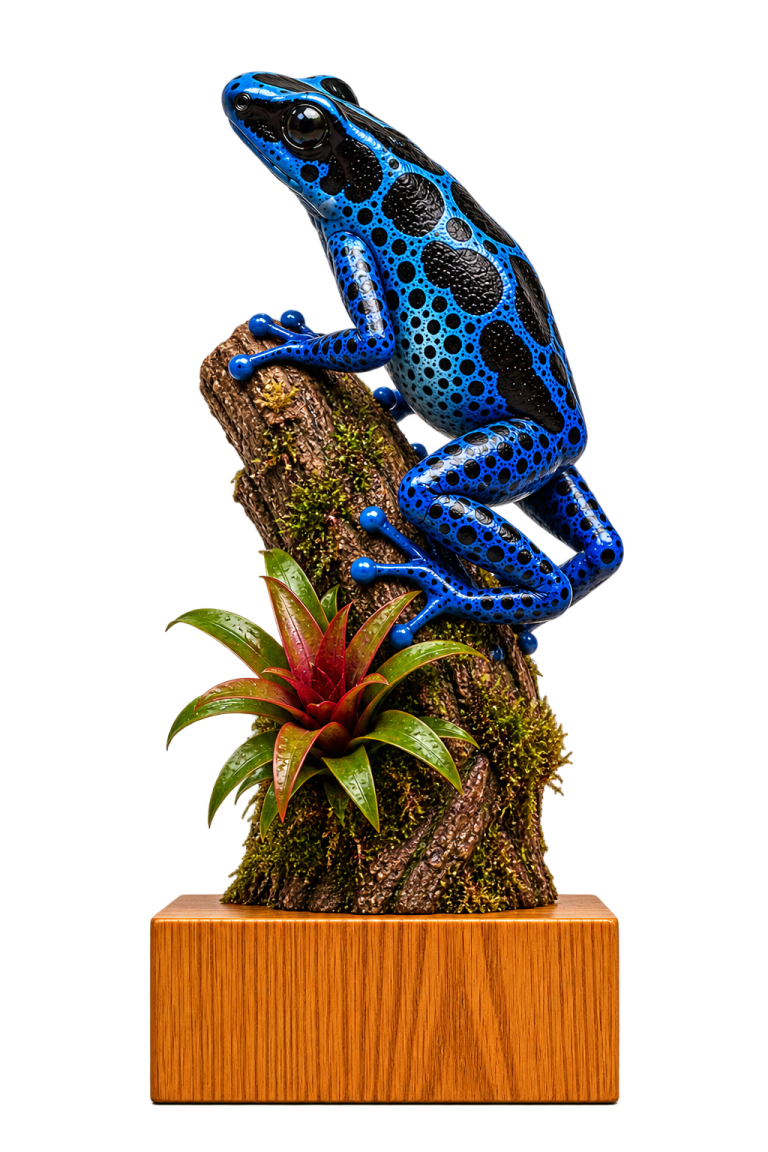
Poison Dart Frog Care Sheet
Different poison dart frog species have different care needs. Before choosing yours, explore the space, conditions and ongoing care each species requires to find a good match for you. The general care guidance below provides a starting point.
If you have questions about an animal you’re considering, many sellers are happy to help. You can message them directly through their listings.
General Care Requirements
The guidance below focuses on three commonly kept species: Dendrobates tinctorius, Dendrobates auratus and Dendrobates leucomelas. These frogs share many practical care requirements, although their behaviour and social compatibility differ. The recommendations cover juveniles and adults, rather than eggs or tadpoles, and should not automatically be applied to every poison dart frog species.
Natural Habitat
These frogs inhabit tropical environments in Central and South America. D. tinctorius occurs in the Guiana Shield region, D. auratus in Central America and northwestern South America, and D. leucomelas in northern South America.
Their surroundings include leaf litter, roots, fallen wood and dense vegetation. These structures provide shelter, hunting opportunities and routes through the habitat. Moisture and temperature vary between exposed surfaces and sheltered spaces beneath vegetation and debris.
Although often described as terrestrial, these frogs also climb. A suitable vivarium should combine usable floor space with accessible branches, planted ledges and sheltered elevated areas.
Housing
For a compatible adult pair, an enclosure measuring approximately 60 × 45 × 60 cm provides a practical starting recommendation for this guide. This is not a scientifically established minimum. Larger enclosures provide more opportunities for exploration, cover and separation, particularly for larger D. tinctorius forms. Groups require additional space and careful management.
Provide a secure, escape-proof enclosure with ventilation that allows air exchange without drying the habitat excessively. Include live plants, cork, stable branches and numerous retreats. Arrange foliage and wood to interrupt sightlines, while leaving accessible areas for feeding.
Use a drainage layer separated from the growing substrate by a suitable barrier. Add approximately 5–8 cm of moisture-retaining, well-drained substrate and a generous covering of leaf litter. Keep the substrate moist rather than saturated, and remove accumulated drainage water before it reaches the growing layer.
Springtails and suitable small isopods can help break down organic material, but they do not replace routine maintenance or a dependable feeding programme. Replenish leaf litter as it decomposes.
Species & Social Housing
- Dendrobates tinctorius: A compatible male-female pair is a sensible arrangement for adult housing. Females may fight, particularly around breeding opportunities. Juveniles living together peacefully does not guarantee continued compatibility after maturity.
- Dendrobates auratus: Compatible pairs and carefully monitored groups can be maintained. Provide abundant cover, including sheltered feeding areas. Female competition and egg predation can occur in breeding groups.
- Dendrobates leucomelas: Compatible pairs or groups can work, with ample climbing opportunities and multiple retreats. Group members still require monitoring, and breeding activity can alter their interactions.
Watch for persistent chasing, wrestling, exclusion from food or a frog becoming unusually withdrawn or thin. Separate incompatible animals promptly. Do not mix species, and keep distinct locality forms separate where breeding could obscure their identity.
Temperature & Humidity
For the three species covered here, aim for daytime air temperatures of approximately 22–25°C, with a modest night-time reduction to approximately 20–22°C. These are practical target ranges, rather than the full range of temperatures the animals might briefly tolerate.
Avoid sustained temperatures above approximately 27°C, and take action before the enclosure approaches 28°C. Heat tolerance depends on exposure and circumstances; do not treat an upper limit as a safe operating temperature.
Most enclosures in a suitably temperature-controlled room do not need a dedicated basking lamp. Lighting can already add considerable heat. Keep the vivarium out of direct sunlight and measure temperatures at frog level as well as near elevated resting places. Any supplementary heating should be thermostatically controlled.
Maintain high humidity, generally around 80–100% in the occupied, sheltered parts of the vivarium. Readings will fluctuate with misting, ventilation and sensor position. Briefly reaching saturation after misting is normal; continuously soaking every surface is unnecessary.
Mist daily as an initial routine, then adjust the amount and frequency to the enclosure. Exposed leaves may lose their surface droplets between sessions, while leaf litter and sheltered retreats should remain moist. Do not allow the habitat to dry out completely or seal the enclosure airtight to maintain humidity.
Water & Lighting
Use water suitable for amphibians. Treat chlorinated or chloraminated tap water with an appropriate conditioner before use. Allowing water to stand does not reliably remove chloramine.
A small, shallow water dish can be provided, with easy access and an uncomplicated exit. Large ponds and deep open water are unnecessary for these adults. Any breeding pools or tadpole-rearing containers require separate planning.
Provide approximately 12 hours of daytime lighting, followed by a dark night period. Suitable LED lighting supports plant growth and normal daytime activity. Include dense cover and shaded retreats.
Low-level UVB can be incorporated, but the lamp, distance and screening must be selected together. The frogs must be able to withdraw from exposure. UVB provision and dietary vitamin D3 should be considered together when selecting a supplementation programme.
Feeding
Offer appropriately sized live invertebrates. Flightless Drosophila melanogaster fruit flies are useful for young frogs, while larger juveniles and adults can also take Drosophila hydei and appropriately sized pinhead crickets. Springtails provide additional small prey, particularly for young frogs.
- Froglets and growing juveniles: Offer food daily.
- Healthy adults: Offer food daily or every other day, adjusting meal size to body condition and reproductive activity.
Begin with a modest portion and observe feeding. Increase provision if food disappears rapidly and the frogs remain lean; reduce it if substantial prey accumulates or the frogs gain excessive weight. There is no useful universal number of fruit flies per frog because feeder size and frog size vary considerably.
Distribute food across more than one location when keeping multiple frogs. Check that every animal feeds successfully. Maintain backup fruit fly cultures so that a failed culture does not interrupt the food supply.
Dust feeder insects with a suitable amphibian calcium and vitamin supplement according to its directions. The programme should provide appropriate calcium, vitamin D3 and vitamin A. Products differ in concentration, so do not apply one product’s schedule to another or routinely combine several fortified products.
Springtails and other enclosure microfauna should be treated as supplementary food, not a complete diet. Tadpoles require a separate feeding and supplementation programme.
Lifespan
For these commonly kept Dendrobates species, plan for approximately 10–15 years of care. Individuals exceeding 20 years have been reported, including D. tinctorius and D. leucomelas. These are husbandry estimates and reported longevity records, rather than a guaranteed lifespan.
Common Health Challenges
- Dehydration: Dry substrate, inadequate misting or excessive drying from ventilation can compromise hydration. Froglets are particularly vulnerable.
- Overheating: Direct sunlight, hot rooms and heat from lighting can raise enclosure temperatures rapidly. Monitor daily maximum temperatures, especially during summer.
- Nutritional disorders: Inadequate supplementation can cause deficiencies, while excessive or overlapping supplements can also cause harm.
- Metabolic bone disease: Problems involving calcium and vitamin D3 can impair skeletal development and movement. Weakness, abnormal posture or difficulty catching prey require veterinary assessment.
- Poor growth or weight loss: Insufficient food, oversized prey, competition, parasites or other illness may be involved. Confirm that the affected frog is actually eating.
- Skin disease: Persistent sores, discolouration or abnormal shedding can have infectious or environmental causes. Do not assume that changing humidity alone will resolve them.
- Chytridiomycosis: Chytrid infection can cause serious disease. Diagnosis requires appropriate veterinary testing; normal appearance does not reliably exclude infection.
- Parasites: Internal parasites can occur in both captive-bred and wild-origin animals. Persistent poor condition or unexplained weight loss may warrant faecal testing.
- Social stress and injury: Aggression and restricted access to food or retreats can cause declining condition even without obvious wounds. Separate incompatible frogs.