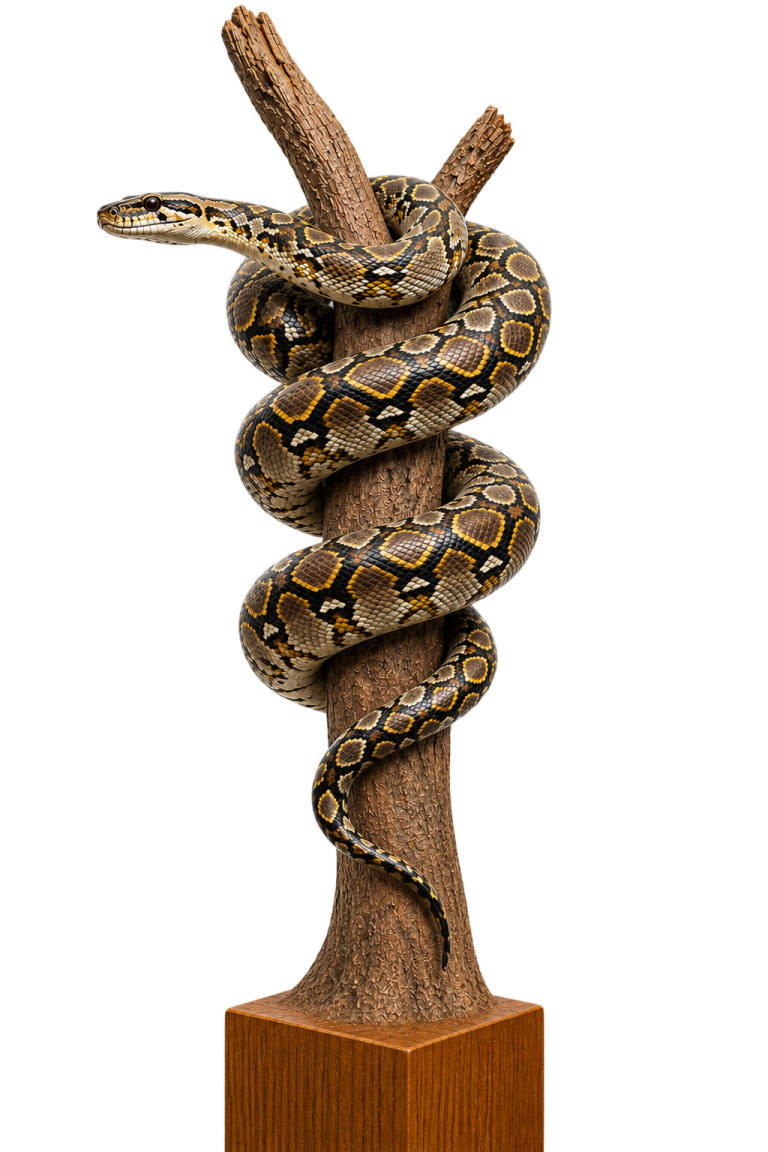
Reticulated Python Care Sheet
Quick Facts
| Species | Malayopython reticulatus |
|---|---|
| Level | Experienced |
| Enclosure | 600 × 300 × 300 cm |
| Temp. / RH | W 28–30°C · C 25–27°C RH ~70% |
| Adult size | 150–600+ cm |
| Lifespan | 15–20 years |
Care & Husbandry
Reticulated pythons are known for their exceptional length, powerful build, intelligence and active behaviour, with adult size varying dramatically between standard, dwarf and super-dwarf bloodlines and localities. This care sheet covers the essential husbandry requirements, including housing, temperature, humidity, feeding, lifespan and common health challenges.
Important: Adult size varies enormously between reticulated python populations and captive bloodlines. Labels such as “dwarf” and “super-dwarf” should not be treated as guarantees of a particular adult size. Housing, handling procedures and long-term planning should be based on the expected adult size and ancestry of the individual animal.
Natural Habitat
Across South and South-East Asia, these pythons use tropical forest and other habitats, often around water. They can climb and swim as well as move on the ground. Island populations differ substantially in adult size, and trade labels such as dwarf or super dwarf do not replace verified ancestry and individual growth records.
Housing
Adult reticulated pythons (Malayopython reticulatus) vary enormously in size, so enclosure dimensions must be based on the expected adult size of the individual rather than a single standard enclosure size. As a general minimum, enclosure length should approximately equal the snake’s full adult length, with width approximately half its length and sufficient usable height for climbing and elevated resting opportunities. Very large standard reticulated pythons may require a purpose-built room or similarly large dedicated enclosure.
Reticulated pythons are active, semi-arboreal snakes and require substantially more than basic floor space. The enclosure should include multiple secure hiding areas, visual cover and exceptionally sturdy branches, platforms or other elevated structures capable of safely supporting the animal’s weight. Larger enclosures should provide sufficient environmental complexity for exploration and natural movement.
A large basin containing fresh water should always be available and should allow the snake to soak comfortably. Where enclosure size permits, a larger water area can provide additional behavioural enrichment. Water must be maintained hygienically and changed whenever contaminated.
A moisture-retaining substrate should help maintain appropriate tropical humidity without remaining continuously waterlogged. Reticulated pythons should generally be housed individually.
A consistent day-night cycle and bright daytime illumination should be provided. Appropriate low-level UVB lighting can be incorporated into the lighting system, with exposure determined by actual output at the animal’s position rather than bulb percentage alone. Shaded areas and hides should remain available.
Large reticulated pythons require careful management because of their exceptional strength and powerful feeding response. Enclosure-access and handling procedures should be established before the animal reaches a size at which safe solo management becomes inappropriate. Sufficient experienced assistance should be available when working with large individuals.
Temperature & Humidity
Provide a thermal gradient that allows the reticulated python to regulate its body temperature. The basking surface should reach approximately 31–34°C, while the cooler portion of the enclosure should remain around 25–28°C.
Basking temperature refers to surface temperature rather than surrounding air temperature. Surface temperatures should be checked with an infrared thermometer, while ambient temperatures should be monitored with accurate digital probes. Heating equipment must be thermostatically controlled, and accessible heat sources must be securely guarded to prevent thermal injury.
A natural night-time temperature reduction can be provided, with temperatures generally falling to approximately 22–25°C.
Ambient humidity should generally remain around 60–80%. Natural fluctuations and temporary higher humidity are normal, but the enclosure should not be maintained continuously near saturation. Appropriate humidity should be maintained throughout the year rather than increased only during shedding.
High humidity must be combined with adequate ventilation. Substrate should retain sufficient moisture to support the required humidity without remaining continuously saturated or unhygienic.
Feeding
Reticulated pythons are carnivorous and should be offered appropriately sized whole vertebrate prey. A varied captive diet can include frozen-thawed rodents, rabbits and suitable poultry, with prey selected according to the snake’s size and body condition.
- Hatchlings: approximately every 7 days.
- Juveniles: approximately every 1–2 weeks.
- Subadults: approximately every 2–3 weeks.
- Mature adults: approximately every 4–6 weeks.
These intervals are general guidelines rather than fixed schedules. Larger meals require correspondingly longer intervals between feedings, and prey size and feeding frequency should always be adjusted according to age, size, sex, activity, reproductive status and body condition.
Reticulated pythons grow rapidly when heavily fed and can become obese when power-fed. Accelerated growth should not be treated as a husbandry goal. Maintaining a lean, muscular body condition is more important than maximising growth rate.
Frozen-thawed prey is preferable to live prey because it reduces the risk of prey-related injury. A balanced whole-prey diet does not normally require routine calcium or vitamin supplementation.
Feeding responses can be extremely powerful, particularly in large individuals. Feeding and enclosure-access routines should therefore minimise accidental bites or constriction incidents, and appropriate experienced assistance should be available when working with animals whose size makes safe solo handling inappropriate.
Lifespan
Reticulated pythons are long-lived snakes. With appropriate housing, nutrition and long-term husbandry, they commonly live for approximately 15–20 years in captivity, while lifespans of approximately 25–30 years are possible.
Common Health Challenges
- Obesity: Excessive prey size, power-feeding or insufficient activity can result in unhealthy weight gain and associated health problems.
- Respiratory disease: Inappropriate temperatures, poor ventilation and persistently wet or unhygienic conditions can contribute to respiratory infections.
- Dehydration and shedding problems: Insufficient hydration or unsuitable humidity can contribute to dehydration and incomplete sheds.
- Thermal injury: Uncontrolled or inadequately guarded heating equipment can cause serious burns.
- Regurgitation: Excessively large meals, inappropriate temperatures, stress or handling too soon after feeding can contribute to regurgitation.
- Inclusion Body Disease: Inclusion body disease associated with reptarenavirus infection can affect pythons and other snakes and may cause neurological, gastrointestinal and other clinical signs. Suspected cases require veterinary assessment and appropriate isolation.
- Stomatitis: Oral injuries, infection and inappropriate husbandry can contribute to inflammation and infection of the mouth.
- Parasites: Internal parasites and external parasites such as snake mites can occur, particularly in newly acquired or exposed animals.